In the race for internationalization, artificial intelligence (AI) appears to be a miracle solution for industrial SMEs and SaaS startups. Translating a showcase website or technical platform into ten languages with a single click is a powerful temptation. However, behind this apparent efficiency lie major risks.
For an industrial SME, a translation error is not just a simple spelling mistake: it is a security breach, a legal risk, and a threat to its intellectual property. Here’s why relying exclusively on AI for your technical content is a risky gamble.
1. Probabilism vs. Determinism: The clash of cultures
The industrial sector is based on determinism. In a factory or CAD software, a precise command must always produce the same result. Conversely, AI is probabilistic: it does not understand what it is saying, it statistically predicts the logical sequence of a sentence.
The danger of technical “hallucinations”:
Language models (LLMs) are prone to hallucinations in about 30% of cases. They can invent a unit of measurement or reverse a polarity simply because the structure of the sentence seems “coherent.”
Lack of discernment:
AI does not know the physical context (temperature, maintenance history, vibrations).
Real-world consequences:
A mistranslation of a load limit or safety instruction can lead to costly equipment damage or even serious workplace accidents.
2. The legal vacuum of intellectual property
For a technology SME, the value of the company often lies in its know-how and intangible assets. However, entrusting its translation entirely to AI weakens this protection.
The impossibility of copyright: In France, as in Europe, only works resulting from human creation are protected. A translation generated autonomously by AI cannot be protected. Technically, it could fall into the public domain.
The need for “human input”: To claim legal protection against competition, you must prove significant human intervention (terminology choices, rewordings, business expertise). Without this, your competitors could legally copy your content.
3. Data security and “Shadow AI”
Using consumer AI tools (such as free versions of certain online translators) exposes your trade secrets.
Model training:
The information you submit (source code, manufacturing processes, proprietary diagrams) is often stored to train future models. Your secrets then become the fuel for AI, potentially accessible to third parties.
Financial impact:
The phenomenon of “Shadow AI” (the use of AI tools by employees without the approval of the IT department) increases the average cost of a data breach by more than $321,000.
4. Strategic risks: SEO and brand image
Your website’s visibility on Google and your customers’ trust are at stake.
Downgrading by Google:
Search engines have become experts at detecting mass-generated content with no added value. Through systems such as SpamBrain, Google can penalize a website whose translations are deemed generic. The result? A loss of organic visibility of up to 70%.
Erosion of customer trust:
Accuracy is a fundamental component of credibility in technical B2B. Industrial customers will perceive a lack of professionalism right away if they notice incorrect terminology, which is frequently the outcome of poorly adapted Anglo-centric datasets. If you don’t have a command of the terms used in your own field, how can you be expected to have a command of the quality of your machines?
5. Legal liability and compliance with the AI Act
The regulatory framework is tightening. Companies can no longer ignore the origin of their content.
Failure to advise:
As a manufacturer or SaaS publisher, you have an obligation to advise. If a translation error misleads a customer, your professional liability insurance could refuse to cover you, arguing that it was an unsupervised algorithmic failure.
Compliance with the AI Act:
Since August 2024, European AI regulations have imposed strict transparency requirements. Certain AI-generated content must be explicitly labeled as such. Failure to comply with these rules exposes companies to heavy financial penalties.
Expert recommendation: The “human-in-the-loop” approach
Does this mean we should ban AI? Not necessarily. The key to success lies in a hybrid approach where humans remain the final guarantor.
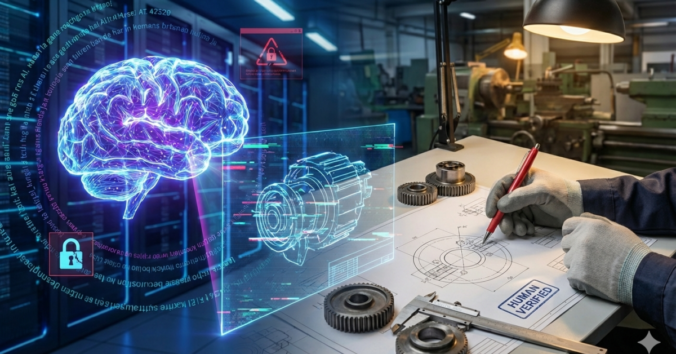
The “human-in-the-loop” principle: AI can be used to generate a quick first draft, but all critical technical content must be validated, corrected, and enriched by a human subject matter expert.
This is the only method that guarantees the technical accuracy, legal protection, and SEO performance necessary for the international growth of an industrial SME.
Before printing your manuals, make sure that no translation errors put your users at risk. Contact me for a linguistic security audit.